HSK Speaking Test Preparation Tips
 HSK Speaking Guide
The HSK Speaking Test assesses how well you can understand spoken Chinese and respond clearly under timed test conditions.
Knowing vocabulary and grammar is only part of the challenge. You also need to listen accurately, organise your response quickly, pronounce Chinese clearly and keep speaking while your answer is recorded.
This guide explains:
The three HSK Speaking levels
The question types at each level
How many questions you will answer
How long each test takes
How HSK 3.0 affects speaking tests
How to practise with HSK Mock
Confirm which HSK format you are taking
HSK Speaking is the official oral Chinese proficiency test associated with the HSK system. It is available at Elementary, Intermediate and Advanced levels, with candidates recording their responses during the test.
If you are taking HSK in 2026, it is especially important to check the exact test format shown during registration.
This guide primarily explains the current Elementary, Intermediate and Advanced HSK Speaking tests.
HSK Speaking Test format comparison
Each HSK Speaking level contains three sections, but the tasks become progressively more demanding as your spoken Chinese develops.
| Speaking level | Main tasks | Questions | Full duration |
|---|---|---|---|
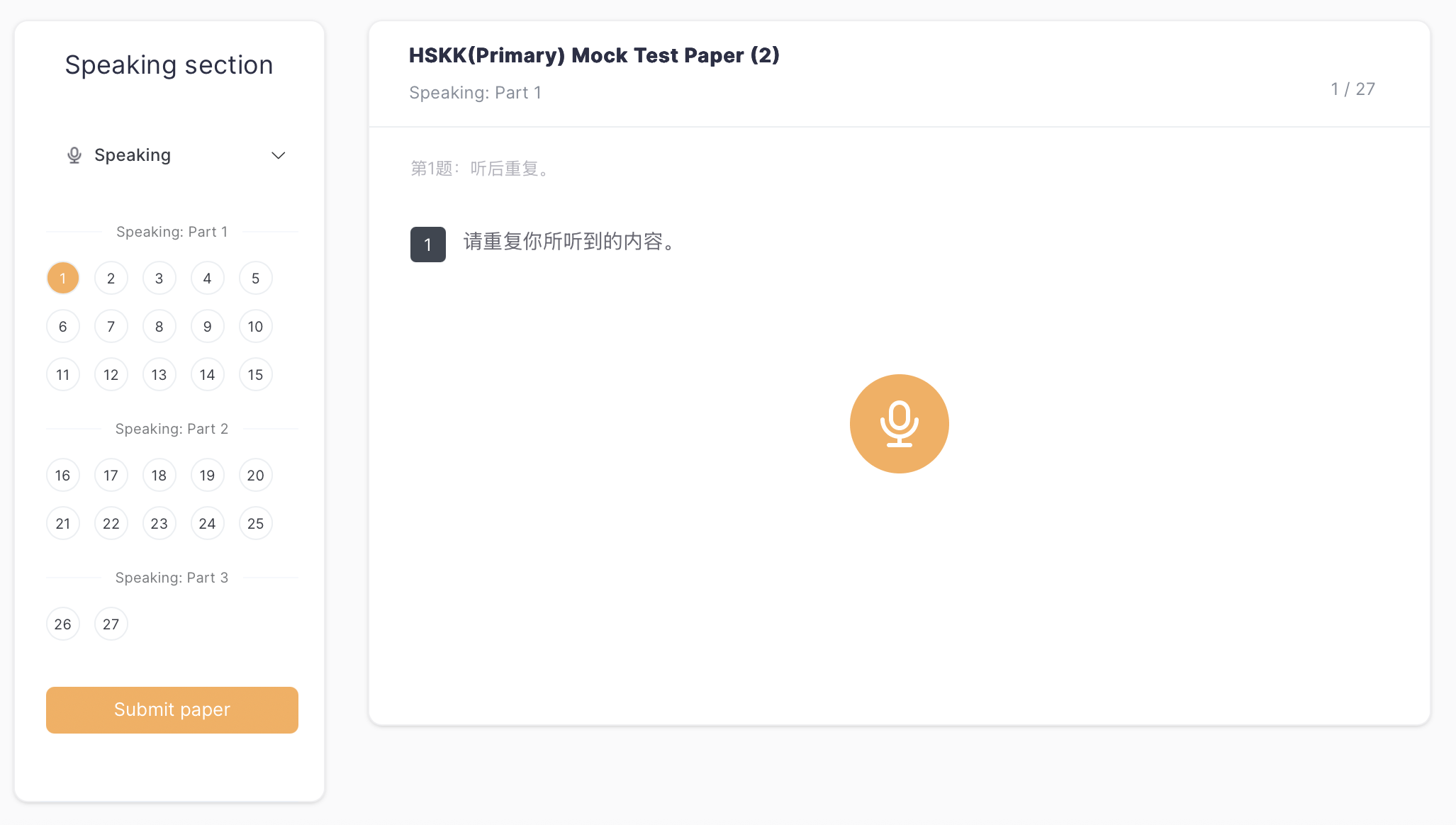
| Elementary | Listen and Repeat Listen and Answer Answer Questions | 27 | About 20 minutes including preparation |
| Intermediate | Listen and Repeat Picture Description Answer Questions | 14 | About 23 minutes including preparation |
| Advanced | Listen and Repeat Read Aloud Answer Questions | 6 | About 25 minutes including preparation |
All three levels are scored out of 100 points. A score of 60 or above is considered a passing result.
HSK Speaking Elementary format
The Elementary test is the first HSK Speaking level and focuses on basic pronunciation, listening comprehension and short spoken responses.
| Section | Task | Questions | Approximate task time |
|---|---|---|---|
| Section 1 | Listen and Repeat | 15 | About 6 minutes |
| Section 2 | Listen and Answer | 10 | About 4 minutes |
| Section 3 | Answer Questions | 2 | About 3 minutes |
| Total | 3 sections | 27 | About 20 minutes including preparation |
The first section tests whether you can hear and reproduce short Chinese sentences accurately.
The second section requires you to understand a spoken question and give an appropriate short response.
In the final section, you respond to two questions with longer spoken answers.
HSK Speaking Intermediate format
The Intermediate test requires more independent speaking. Candidates must reproduce sentences, describe visual information and develop longer spoken responses.
| Section | Task | Questions | Approximate task time |
|---|---|---|---|
| Section 1 | Listen and Repeat | 10 | About 5 minutes |
| Section 2 | Picture Description | 2 | About 4 minutes |
| Section 3 | Answer Questions | 2 | About 4 minutes |
| Total | 3 sections | 14 | About 23 minutes including preparation |
Picture description is one of the major differences at this level. You need to organise several connected sentences rather than simply producing a short answer.
Fluency also becomes more important because hesitating for too long can make it difficult to complete your response within the available time.
HSK Speaking Advanced format
The Advanced test requires candidates to understand longer spoken material, reproduce information accurately, read Chinese aloud and express developed ideas in Chinese.
| Section | Task | Questions | Approximate task time |
|---|---|---|---|
| Section 1 | Listen and Repeat | 3 | About 8 minutes |
| Section 2 | Read Aloud | 1 | About 2 minutes |
| Section 3 | Answer Questions | 2 | About 5 minutes |
| Total | 3 sections | 6 | About 25 minutes including preparation |
At Advanced level, the number of questions is much lower, but each task requires substantially more Chinese.
Candidates need stronger listening memory, clearer organisation, accurate pronunciation and the ability to speak continuously about more complex topics.
How does HSK Speaking change between levels?
The test moves from controlled repetition toward increasingly independent spoken communication.
What does the HSK Speaking Test assess?
A strong speaking result is not simply about speaking quickly. Your answer needs to be understandable, relevant to the task and appropriate for your level.
Pronunciation and tones
Clear initials, finals and tones help the listener understand your meaning. A small mistake does not necessarily ruin an answer, but repeated pronunciation problems can reduce clarity.
Listening comprehension
Several HSK Speaking tasks begin with listening. You need to understand the sentence or question before you can produce an appropriate response.
Fluency
Long pauses and repeated restarts can make your response less effective. Practising under time limits helps you continue speaking even when your answer is not perfect.
Vocabulary and grammar
Use language you can control accurately. Simple, complete sentences are often more effective than overly complicated structures that cause hesitation or errors.
Organisation
At Intermediate and Advanced levels in particular, your ideas need a clear order. Opening your response, developing the main idea and ending clearly makes longer answers easier to follow.
How to improve your HSK Speaking score
General Chinese study is important, but speaking preparation should also reproduce the conditions of the actual test.
Practise speaking aloudSilent vocabulary review does not train speaking. Spend part of every study session producing Chinese aloud.
Use shadowing for repetition tasksListen to a short Chinese sentence and repeat it immediately. Copy the pronunciation, rhythm, pauses and intonation as closely as possible.
Record your own answersListen back for unclear pronunciation, repeated filler words, long pauses and sentences that are difficult to understand.
Practise answering without translating firstBuild the habit of responding directly in Chinese. This reduces hesitation and helps you react more naturally.
Train under realistic time limitsDo not pause the recording whenever you make a mistake. Learn to recover and continue speaking just as you will need to do during the test.
Complete a full HSK Speaking mock testA complete mock test shows whether you can maintain your pronunciation, fluency and concentration throughout the full exam.
A simple weekly HSK Speaking practice plan
You do not need to complete a full mock test every day. A combination of short skill practice and realistic test practice is usually more useful.
| Practice | Suggested frequency | Main purpose |
|---|---|---|
| Pronunciation and shadowing | 3 times per week | Improve tones, rhythm and repetition accuracy |
| Short spoken answers | 3 times per week | Reduce hesitation and develop automatic responses |
| Longer speaking tasks | 2 times per week | Improve organisation and continuous speech |
| Full mock test | Once per week | Practise the complete format under realistic conditions |
| Recording review | After each mock test | Identify pronunciation, fluency and content weaknesses |
Practise HSK Speaking online
HSK Mock lets you practise the speaking test online using authentic HSK exam content and realistic speaking tasks.
Choose your HSK Speaking level
Practise the real test structure
Record your responses directly online
Experience realistic test timing
Receive a score and professional feedback within 48 hours
Identify what to improve before your official test
Frequently asked questions
What is the HSK Speaking Test?
The HSK Speaking Test assesses oral Chinese proficiency. Candidates listen to prompts and record spoken responses. The test is offered at Elementary, Intermediate and Advanced levels.
Is HSK Speaking the same as HSKK?
HSKK is the name traditionally used for the HSK oral examination. The current Chinese Test Service Website presents the assessment in English as the HSK Speaking Test.
How many HSK Speaking levels are there?
There are three current levels: Elementary, Intermediate and Advanced. Each level has three sections but uses different speaking tasks.
How long is the HSK Speaking Test?
Elementary takes approximately 20 minutes including preparation, Intermediate approximately 23 minutes and Advanced approximately 25 minutes.
What is the passing score for HSK Speaking?
Each current HSK Speaking level is scored out of 100 points. A total score of 60 or above is considered a passing result.
Do I speak to an examiner?
The HSK Speaking Test uses recorded responses. You listen to the test material and record your answers rather than having a face to face conversation with an examiner.
Does HSK Level 3 include speaking?
Speaking is not a section inside the regular current format HSK Level 3 written paper. HSK Speaking is a separate assessment. For selected HSK 3.0 trial sessions, candidates taking Levels 3 to 6 are required to register for the corresponding speaking test.
Which HSK Speaking level should I take?
Elementary is commonly associated with learners around HSK Level 3, Intermediate with HSK Level 4, and Advanced with HSK Levels 5 and 6. However, you should always follow the test requirement shown during your registration.
How can I practise HSK Speaking online?
Practise the actual task types, record your answers and use realistic preparation and response times. A full HSK Speaking mock test helps you experience the complete process before the official exam.
How quickly does HSK Mock provide speaking feedback?
HSK Mock currently provides speaking evaluation and professional feedback within 48 hours after the speaking mock test is submitted.
Build your HSK Speaking confidence before test day
Strong speaking performance comes from practising the exact skills the test requires. Learn the format, record yourself regularly and complete a full timed mock test before your official exam.
Start HSK Speaking Practice
